

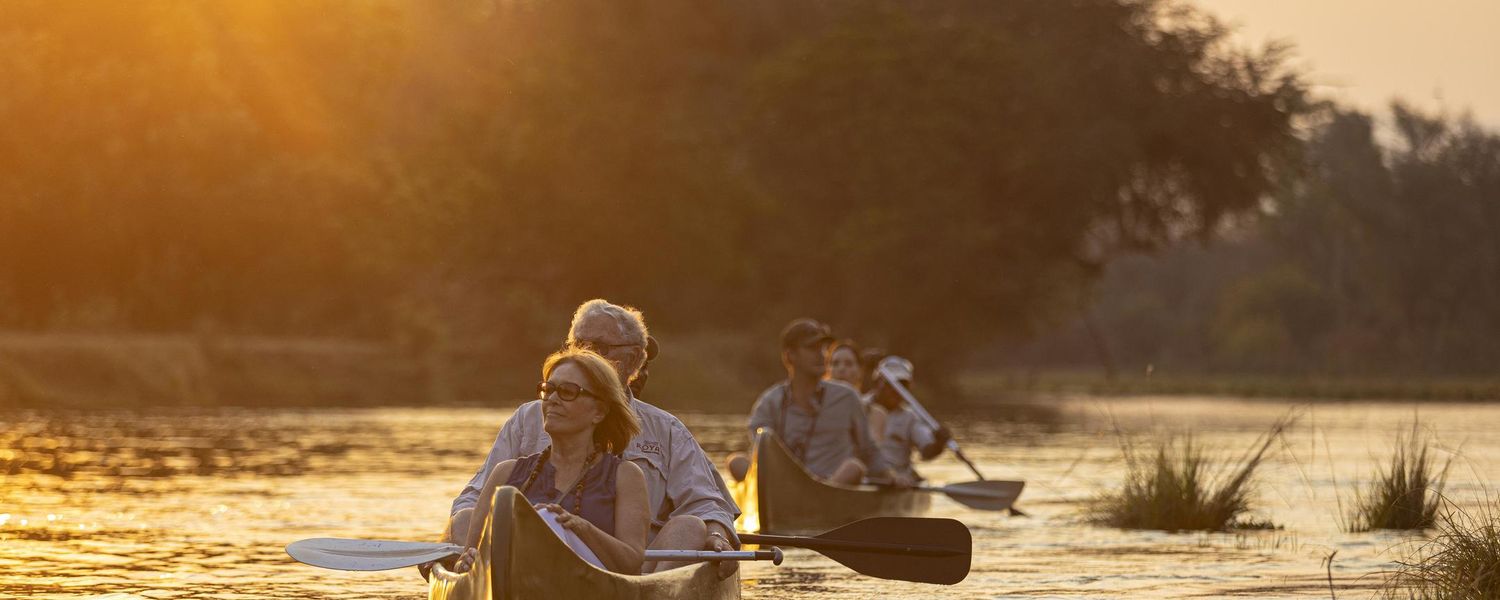
Safaris for older travellers
Answers to the questions older travellers ask most about African safaris, three safaris that suit you well, and the one we'd recommend.
This page is for you if you're an Australian or New Zealander in your sixties, seventies or beyond, and you want to see Africa's wildlife on a trip that is comfortable and well looked after from start to finish. Perhaps it's your first safari, or perhaps you've been before and want to go again without the long road transfers and physical demands you'd happily leave to younger travellers.
Below we answer the questions older travellers ask us most often, set out three safaris that suit you well, and tell you which one we'd recommend and why.
Is an African safari safe for older travellers?
For most older travellers, a well-planned safari is very manageable: the risks that matter at this stage of life are largely in the planner's hands, and we design the itinerary around them.
More detail
We understand the question, and the reason for asking it. Experiential Travel's founders are in their sixties and seventies and travel to Africa regularly, so the transfers, camps and long flights we plan are ones they make themselves, at the same stage of life as you. Between them they know both what Africa asks of a visitor and what makes it comfortable.
The risks that matter most at this stage of life, such as long road transfers, distance from medical care, physical strain and tight connections, are largely in the planner's hands. No journey, at home or abroad, is entirely free of risk, but we design every itinerary to reduce these before you leave home.
We plan for our guests the same way we would for our own sisters and daughters. Every routing, transfer and camp we propose is one we'd be content for a member of our own family to do. Where we can't say that without qualification, we change the plan.
We check the Australian Government's Smartraveller advice for every country on your itinerary, and we also follow the US State Department, the UK Foreign Office and other agencies with larger resources on the ground, because they often see specific risks first.
Safety and comfort are different questions, and older travellers sometimes worry about one when they mean the other. A trip can be well planned and still be tiring if it moves too often or starts too early. We consider both: whether we'd be content for our own family to do it, and whether the pace lets you finish the trip wanting more rather than needing a rest.
Which country is best for a first safari when you're over 60?
For most older travellers on a first safari, South Africa is the easiest place to start: English is an official language, there are direct flights from Australia and the USA, and you can choose comfortable private reserves, a malaria-free reserve, or a few days in Cape Town alongside.
More detail
South Africa's private reserves in the Greater Kruger, such as Timbavati, Klaserie and Manyeleti, offer excellent game viewing with guided drives in open vehicles, and there are even more luxurious options in the Sabi Sand. The whole area, including the Kruger National Park itself, is unfenced, so the animals move freely between the reserves and the park. If you'd prefer to avoid malaria altogether, Madikwe, near the Botswana border, is one of several malaria-free Big Five reserves, just over an hour's flight from Johannesburg.
Botswana suits travellers who want somewhere quieter and wilder. Light aircraft fly you between camps, so you spend hardly any time on roads. Be realistic about the planes, though: the usual aircraft is a 12-seat Cessna Caravan, luggage limits are strict, and climbing in and out of it is awkward, even for agile travellers.
Tanzania is the choice if the great wildebeest migration or the Serengeti is the dream. Distances are large, so for older travellers we build it around flights between parks rather than long drives, and you can route your arrival so that no yellow fever certificate is needed.
There's no single right answer; it depends on what you most want to see and how much moving around suits you. We'll talk it through with you before suggesting anything.
When is the best time to go at our age?
For a southern African safari, July to September is the best time to go: the vegetation thins and the waterholes dry up, so the animals gather at the remaining water and are far easier to see. October is excellent too, if you can tolerate very high daytime temperatures.
More detail
The southern African dry season runs from about May to October. As it goes on, the bush opens up and the wildlife concentrates, which is why the later months give the best game viewing. July mornings can be very cold in an open vehicle, so dress in layers for early drives; by September the days are warm and the mornings milder. In October the heat builds sharply, often well into the thirties, and you'll appreciate a camp with shade, a pool and a long midday rest.
In Botswana, the Okavango Delta's floodwaters arrive in the dry season, usually peaking around the middle of the year, which is when boat and mokoro activities are at their best. By November, water levels are very low and those activities are limited.
In Tanzania, timing follows the migration rather than the weather: the herds calve in the southern Serengeti early in the year, and the dramatic river crossings happen in the north from about July to October. We'll match the timing to what you most want to see.
The summer months, November to March, are hotter and wetter, with lush green landscapes, newborn animals and fewer visitors. It's also the best time of year for birdwatchers, when migrant species arrive from Europe and elsewhere in Africa. The heat and humidity are harder going, though, and malaria risk is higher where it exists.
How do I avoid long, tiring transfers between camps?
Stay longer in fewer places, fly rather than drive between regions where it helps, and rest for a night after your long-haul flight before you go on to the bush.
More detail
The most tiring part of most safaris isn't the game drives; it's the travel days in between. We keep the number of moves low, so you unpack and settle rather than repacking every second morning. Where two areas are far apart, we use scheduled or light-aircraft flights instead of long road transfers, and we try to time them so you arrive in camp around lunchtime, rested enough to enjoy the afternoon drive. That isn't always possible, but it's what we aim for.
We always recommend a rest night in a comfortable hotel or resort after a long-haul flight, so you start your safari fresh rather than straight off an overnight journey.
We don't set a maximum time for road transfers, because the road matters more than the hours. A four-hour drive to Madikwe on good tar is far easier than two hours weaving between potholes in Zimbabwe. We've driven these roads ourselves, so we can tell you honestly what a transfer will be like before you book.
Can I go somewhere malaria-free?
Yes. South Africa has several malaria-free reserves where you can see the Big Five, including Madikwe, Welgevonden and reserves in the Eastern Cape.
More detail
If you'd rather not take antimalarial medication, or your doctor advises against it, a malaria-free reserve removes the question entirely. Madikwe, near the Botswana border, is just over an hour's flight from Johannesburg; Welgevonden, in the Waterberg, is a few hours' drive north of Johannesburg; and the Eastern Cape has several malaria-free Big Five reserves within easy reach of the Garden Route.
The Greater Kruger, Botswana, Zimbabwe, Zambia and Tanzania are all malaria areas. Many older travellers visit them comfortably, and the risk is generally lower in the dry winter months, but you'll need to discuss prevention with your doctor or a travel clinic before you go. We can't advise on medication, but we'll tell you which parts of your itinerary are in malaria areas so you can have that conversation early.
Do I need a yellow fever certificate?
Not for South Africa, Botswana, Namibia, Zimbabwe, Zambia or Tanzania, provided you don't arrive from, or connect through, a country where yellow fever is transmitted.
More detail
These countries ask for a yellow fever certificate only if you arrive from a yellow fever country, such as Kenya or Ethiopia. Flying in from Australia, New Zealand, the USA or Europe, that is usually straightforward. A connection can change it, though: how each country treats a transit stop varies, and it can change from one year or season to the next. So the requirement has to be checked when your flight routes are booked, not just when the trip is planned. We check it border by border, in the order you'll cross them, at the time your flights are booked.
Do I need the yellow fever vaccine if I'm over 60?
South Africa, Botswana, Namibia, Zimbabwe, Zambia and Tanzania are not in the WHO's declared yellow fever transmission zone, so a safari in these countries need not involve the vaccine, provided your route doesn't require a certificate.
More detail
That matters more as you get older. The yellow fever vaccine contains a live virus. The UK's medicines regulator advises that people aged 60 and over should have it only where there is "a significant and unavoidable risk of acquiring yellow fever infection" (MHRA, Drug Safety Update). The same guidance says the vaccine is not given to people whose immune system is suppressed. A safari in these six countries spares you that decision. Talk to your doctor or a travel clinic about your own health before you travel.
What about the heat and the rough roads?
Both are real, and both can be planned around: choose the cooler months, keep to a gentle daily rhythm, and choose your seat in the vehicle.
More detail
Safari days follow the heat. Game drives run in the early morning and late afternoon, when the animals are most active and the air is coolest, and the middle of the day is for lunch, rest and the pool. You can always skip a drive if you're tired. If heat troubles you, travel between July and September and avoid October, when temperatures often climb well into the thirties.
East Africa surprises most people. Although Tanzania sits close to the equator, its safari areas are high: much of the Serengeti lies well above 1,000 metres and the Ngorongoro Crater rim above 2,000 metres, so days are pleasantly warm and mornings and evenings can be distinctly cool.
Game-drive tracks are unsealed, and some are rough. Open safari vehicles have good suspension, and guides drive slowly when they're watching for animals, but there are bumps, dips and the occasional dry riverbed to cross. If you have back or joint problems, tell us when we're planning, and when you're there, ask for the seat next to your guide. It is the smoothest ride in the vehicle, and although it sits a little lower than the rows behind, you see everything your guide sees.
Drink more water than you think you need, wear a hat, and bring a light layer for the evening; the temperature drops quickly once the sun goes down.
What happens if I need a doctor on safari?
Every safari vehicle carries a two-way radio to its lodge or camp, and every lodge or camp can reach the outside world, including medical support, in real time. In an emergency, your guide and the camp mobilise the help you need.
More detail
Safari camps are remote, so serious medical care means being moved to it rather than a doctor coming to you. Your guide radios the camp, and the camp calls in medical support and arranges evacuation by road or air to a hospital.
This is when your insurance details matter most. Some evacuation services will not mobilise until they have them, which is why we ask for your insurer and policy number on your traveller profile, and pass them to the people looking after you on the ground. Comprehensive travel insurance is a requirement for every trip we arrange.
Medical evacuation and repatriation are different things. Evacuation moves you from where you are to a hospital, often in an African city. Repatriation brings you home. Policies differ on both, so be clear about what yours provides. We are not able to advise on insurance; please seek advice from a licensed insurer or adviser, and tell them about any medical condition you have.
Your traveller profile also records any medical conditions, mobility needs, allergies and diet, so the camps know about you before you arrive. See your doctor or a travel clinic well before you leave, and bring enough of your regular medication for the whole trip plus a few days' spare, in its original packaging, in your hand luggage.
What are the safari vehicles and camps like to get around?
Comfortable, but not built for easy access. There are steps into the vehicles, steps up to the tents, and paths to walk after dark, so tell us how you move and we'll take it into account when we choose where you stay.
More detail
Most game drives are in open four-wheel-drive vehicles with tiered rows of seats. You climb in using a step and a handrail, and the higher rows mean a bigger step up. The seat next to your guide is the easiest to get into as well as the smoothest ride.
Many camps put their rooms or tents on raised wooden decks, reached by a few steps, with paths or walkways between your room and the main area. Every room has its own bathroom. Some properties are more spread out than others, so if walking distance matters to you, tell us, and we'll ask for a room close to the main area. We can ask, but we can't guarantee it.
Many safari camps are unfenced, and animals walk through them, particularly at night. Almost every safari property we book insists that a member of staff escorts you between your room and the main area after dark. The only exceptions are places with no dangerous animals, such as city hotels and beach lodges. The walk is one of the most memorable parts of a safari, and it means you never walk alone in the dark.
If you use a walking stick, have trouble with steps, or need a shower rather than a bath, put it on your traveller profile. The camps receive it before you arrive.
How many nights should I stay in each place?
For most older travellers on a limited budget, three nights per safari camp is the sweet spot, and two is the minimum. If your budget allows, stay longer. Fewer moves means less packing, fewer transfers and more time actually on safari.
More detail
Every move costs most of a day. You pack, check out, transfer by road or light aircraft, check in and settle, and the game drive you would have had that morning or afternoon is often lost. On a two-night stay, one of your two full days goes on travel.
Three nights gives you two full days in camp. You learn the routine, get to know your guide, and can skip a drive to rest without feeling you've missed the place. Your guide also gets to know what interests you, and the drives get better for it. Four nights or more is better still, and you'll feel the difference in how relaxed the trip is.
It's natural to want to see as much as possible. We've had requests for two nights in each of three camps in the Greater Kruger. That makes sense if you're researching a guidebook, but it costs you the safari itself: you spend your time packing and transferring between camps that share much the same wildlife and landscape, instead of settling into one. If you're torn between two camps or reserves, we would usually suggest choosing one and staying longer.
Allow a rest night in a comfortable hotel after your long-haul flight, before your first safari camp, and consider a night in a city or at a beach lodge at the end, before you fly home.
Should I join a group tour or travel privately?
Both work well for older travellers. A group tour costs less and gives you company, while a private safari moves at your pace. Many people find the best of both is a private itinerary where you share game drives with other guests at each lodge.
More detail
On a group tour you travel with a set group on fixed dates and a fixed route, always with a tour guide. It's the most economical way to go, the logistics are handled for you, and many people enjoy the company. The trade-off is the pace: the group moves on the group's schedule, so there's less room to rest when you need to or to linger where you're happy.
On a private safari we design the itinerary around you: your dates, your pace, and the camps that suit how you travel. At most lodges and camps you share an open vehicle with a few other guests on game drives, which many people enjoy. If you'd rather have the vehicle to yourselves, most properties can arrange a private vehicle at extra cost. That way the guide can stop as long as you like and set off when you're ready. At mealtimes they'll seat you at your own table, or you can invite your fellow travellers to join you.
We arrange both group tours and private safaris, so you can choose on what suits you rather than on what we happen to sell.
What happens if something goes wrong while I'm away?
We keep watching your trip while you travel. Our Safari Sentinel service monitors your scheduled flights around the clock for delays and cancellations, and every guest has a clear chain of people to call, ending with us.
More detail
Things sometimes change on the ground. A flight is cancelled, a road is washed out, or a connection runs late. Safari Sentinel tracks the scheduled flights on your itinerary, day and night, and alerts us to delays and cancellations, often before you know about them, so we can start working on the fix. Light-aircraft and charter flights between camps don't publish to the systems we monitor, so the teams on the ground look after those.
If you need help, start with the people nearest to you: the lodge, camp or transfer company you're with. Every lodge and camp we book has its own procedure for handling problems, and they keep us informed, consulting us if a decision affects your trip. If they can't resolve it, call our partner in that country, who arranges your ground services. If you still need us, call us directly. All three are listed in your itinerary.
When a supplier cancelled one couple's flight three weeks before they travelled, we treated it as if they were our own family. We rebuilt their day around the earliest alternative flight, a meet-and-assist service through the airport, and a transfer timed to reach their reserve before its gate closed. Every leg was one we had travelled ourselves, so we knew it would work.
How do I choose a safari company?
Choose a company that matches the trip to you: one that knows the camps first-hand, designs around how you like to travel, and keeps looking after you once you've left home.
More detail
Ask whether the people designing your trip have stayed at the camps they recommend. First-hand knowledge is the difference between a property that looks right in the brochure and one that suits how you travel: the number of steps to your tent, the length of the walk to dinner, the road to the airstrip.
Look for a company that starts with you rather than with a product. A good one asks how you like to travel, what you hope to see and what you'd rather avoid, and it is honest when something on your wish list wouldn't suit you.
Ask what happens once you're there. Who monitors your flights, who do you call when something goes wrong, and will the company you booked with still be involved?
Check that the price is clear: what it includes, what it doesn't, and whether it includes flights. A clear price, including what isn't covered, is a sign of a company that won't surprise you later.
The ideal company is well connected at both ends of your trip. At the African end, membership of ATTA, the African Travel and Tourism Association, means close working relationships with the camps, lodges and ground operators, which gives you a wider choice of properties and smoother arrangements.
At the home end, look for a company accredited by ATIA, the Australian Travel Industry Association. Accreditation means the business has met ATIA's requirements for financial resilience and operational integrity. Booking with an Australian business also gives you the protection of Australian Consumer Law, which you don't have when you book directly with a company overseas.
Experiential Travel is a member of ATTA and ASTA, and is accredited by ATIA.
Three safaris that suit older travellers
South Africa: the easiest first safari
English is an official language, there are direct flights from Australia and the USA, and you can choose malaria-free Big Five reserves such as Madikwe, just over an hour's flight from Johannesburg.
Our itinerary: Greater Kruger, Madikwe and Victoria Falls, 15 days / 14 nights. From A$7,495 per person, not including flights, for a group of two couples in two double rooms.
Botswana: the wildest, at a slower pace
Remote, uncrowded, and reached by light aircraft. It's the place to be if you want wilderness, and you're happy to manage the step up into a 12-seat Cessna Caravan.
Our itinerary: Botswana Revealed, 7 days / 6 nights. From A$13,782 per person, not including international flights.
Tanzania: big landscapes, cooler air
High safari country, where days are pleasantly warm and mornings and evenings are cool. Three camps in ten days take you from the Ndutu calving grounds to the predator-rich Central Serengeti.
Our itinerary: Best Value Safari: Tanzania High Season, 10 days / 9 nights. From US$11,987 per person sharing, February 2027, not including international flights.
Our recommendation
If this is your first safari, start in South Africa. Choose the Greater Kruger or a malaria-free Big Five reserve such as Madikwe, travel between July and September, and stay three nights or more in each camp.
Arrive a day early and rest after your long-haul flight. Keep the moves few and the transfers short, and take the seat next to your guide. That one trip will tell you how you like to travel in Africa, and if you catch the bug, as most people do, Botswana and Tanzania will be waiting for your next one.
If you already know Africa, or want something wilder, Botswana is the next step. If you want the great herds and cooler air, choose Tanzania. Either way, tell us how you travel, and we'll match the trip to you.
How we look after you
Before you go, while you're away and after you're home, the same people who designed your trip are looking after it.
- Before you go: We design around how you travel, choose properties for their fit to you, and ask for a traveller profile so every camp knows your needs, your diet and your insurance details before you arrive. We set out your entry requirements border by border.
- Our safety test: Before we put anything in front of you, we ask one question. Would we be content for a member of our own family to do this alone? If the answer is anything short of an unqualified yes, it isn't in your itinerary.
- While you're away: Safari Sentinel monitors your scheduled flights around the clock, every lodge and camp keeps us informed, and you always have a clear chain of people to call, ending with us.
- After you're home: We ask every guest how it went, and we pass what you tell us on to the people who looked after you.
When you're ready, tell us how you like to travel and we'll start shaping a trip around you.
Share This Page